
NSD2 is constitutively overexpressed in t(4;14) MM because of the translocation, and is thought to be a primary oncogenic driver of t(4;14) MM. However, due to the lack of appropriate tools, the proximal NSD2 targets and the molecular mechanisms of regulation remain largely unknown, hindering the exploitation of NSD2 as a therapeutic target. Drs. Yubao Wang and Gareth Morgan along with colleagues at NYU Langone Health and collaborators reported important progress in such aspects in a recently published Blood paper.
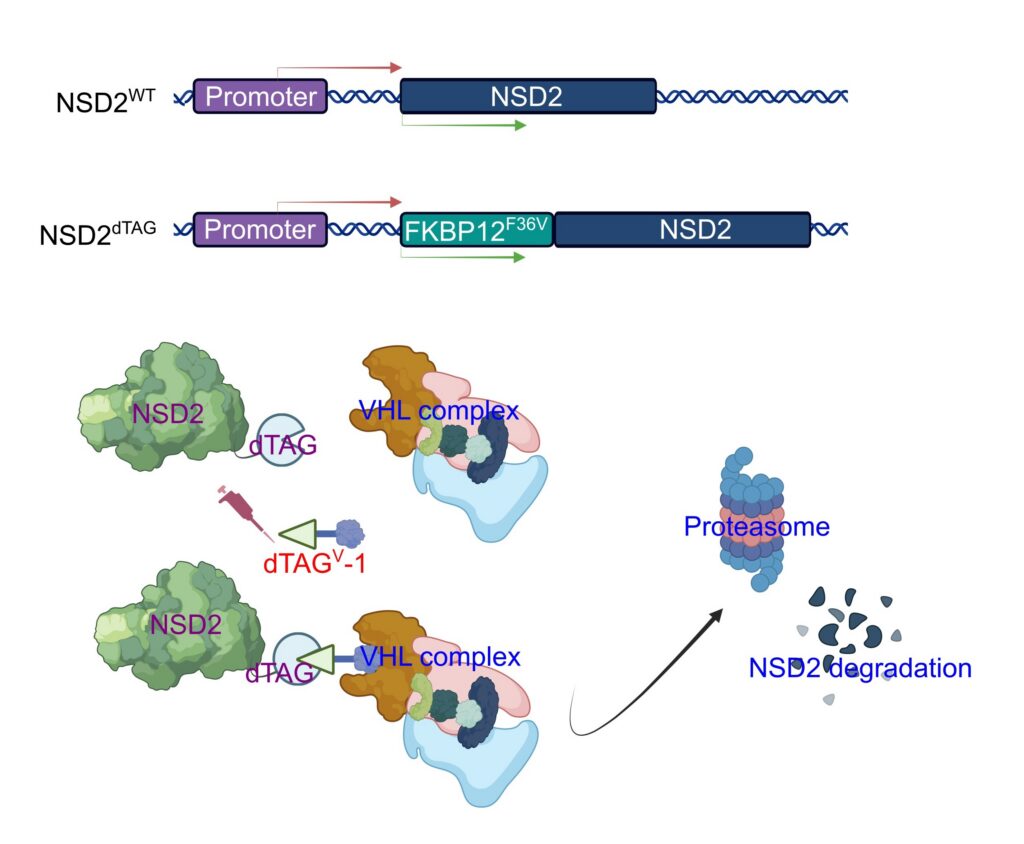
Investigators generated a novel degron system (i.e. dTAG) of NSD2 that allows for its inducible acute degradation. Using this model, investigators found that NSD2 is not essential for cell viability but its depletion only mildly inhibits cell growth. To understand the molecular impact of NSD2, they employed the cutting-edge time-resolved SLAM-seq to identify 307 proximal transcriptional targets of NSD2. Reconstitution with either wild-type NSD2 or a catalytically inactive mutant NSD2 showed an almost exclusive dependency on its SET domain activity. Mechanistically, CUT&Tag analysis showed that H3K36me2 deposited by NSD2 antagonizes the levels of the repressive H3K27me3 deposited by PRC2. Experiments with PRC2 inhibitors revealed that regulation of approximately 50% of the NSD2 target genes is mediated by the impact on H3K27me3 exerted by H3K36me2. Moreover, the regulation of H3K27me3 preferentially occurs in the intergenic regions of the genome rather than NSD2 target genes per se. This suggests that NSD2, via H3K36me2, creates a transcriptionally active chromatin landscape by regulating cis-regulatory genome, including enhancers, through inhibiting the repressive H3K27me3 – a de-inhibition mechanism. Another novel finding in this study is that NSD2 target genes are enriched for oncogenic signaling proteins and particularly transcriptional factors (TFs), including 8 TFs that are known oncogenic drivers in B-ALL and MM, reenforcing the role of NSD2 as an oncogene in t(4;14) MM and suggesting a plausible mechanistical basis, which warrants further investigation.
Identification of proximal NSD2 target genes and elucidation of the molecular mechanisms pave the way for potential therapeutic interventions in t(4;14) MM. In addition, this experimental system, by the advantage of its inducibility and tunability, can now be used in large-scale screens to identify synthetical lethality targets that, with NSD2 depletion, can selectively kill NSD2-driven tumor cells such as those of the t(4;14) MM.